Our PARISHES

Alphabetical selection of parish town

Come Journey with Us

We are companions on the journey, breaking bread and sharing life;
And in the love we bear is the hope we share for we believe in the love of our God...

Mass Times:

  • 1st Sunday of the Month: 10:30am (followed by morning tea)
  • 2nd – 5th Sundays of the Month:    8:30am
  • Weekday Masses: No weekday Masses
  • Reconciliations: By Appointment


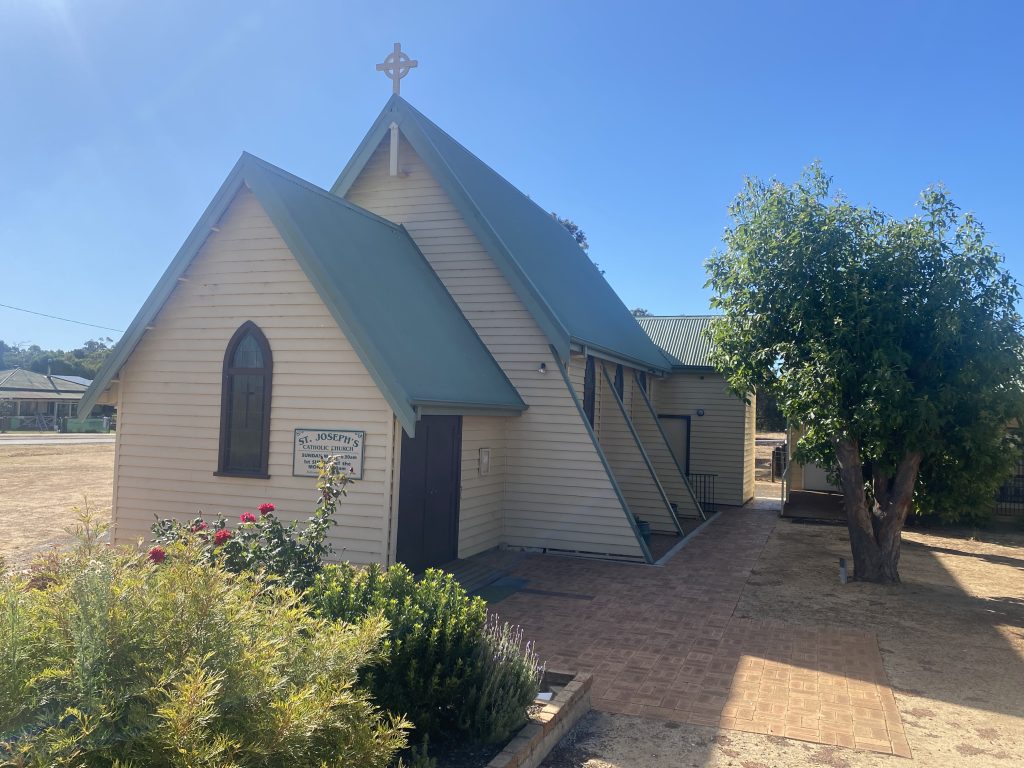
History – Capel (Mass Centre)

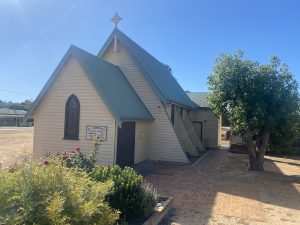
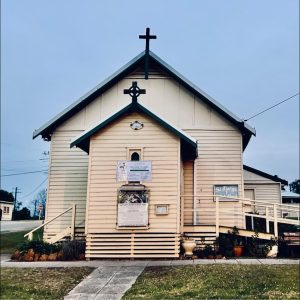
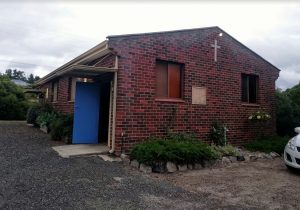
St Joseph’s Church is located on Capel Drive, Capel.  Land was acquired for the Church in the 1890’s, and additional blocks donated by Mrs.  Kathleen Hardey in the 1950s. The Church was built in 1913 in a simple federation carpenter gothic architectural style.  Around 1918 buttresses were added.  St Joseph’s Church represents the continuity of the Catholic Church’s presence on the site since 1913, and associations dating back to 1881, when it was serviced from Busselton for Sunday Mass once a month.  

In 1942 Capel became part of the Donnybrook Parish.  

In 1993 the Parish community – who have great pride in maintaining a continuity with the early faith community – undertook a restoration project, where the Church was restumped, a new green roof and new cream cladding were added, leadlight windows were altered, the entry foyer was extended, and the front door was replaced.  An adjacent community Room was constructed by the community in 2023.


PARISH PRIEST

Rev. Fr. Wayne Bendotti (Donnybrook)

Mass Times

St Brigid Collie

Saturday 6:00 PM

Sunday 10:00 AM


Darkan

1st and 3rd Sunday 8:00 AM


Reconciliation

Every Saturday at 5:00 PM

Collie Parish – History

As we approach the Third Millennium, the year 2000, Collie will celebrate its own Centenary. Although given the name Collie, after Dr Alexander Collie, in 1830 it waited till 1897 to be names a townsite. Just two years later, in 1899, St Brigid’s parish was established. Since 1938 Darkan has been served from Collie Parish for all but seven years.

The Catholic community is proud to have a living tradition with this rich past in the Presentation Sisters who came here in 1902 and are very much with us still. The Franciscan Friars have served the parish since 1960 and the Franciscan sisters came in 1981. Now we are joined by the Good Samaritan Sisters this year.

In 1899 St Brigid’s Parish was established. First Parish Priest was Fr Patrick Briody.

April 1900: Dedication of the first church. End of 1900 small presbytery built.

1902: Arrivals of Presentation Sisters to open first school.

November 1902: Father D O’Donnell appointed in charge of parish.

August 1903: Blessing and opening of convent.

1913: School hall built.

1921: New Presbytery built.

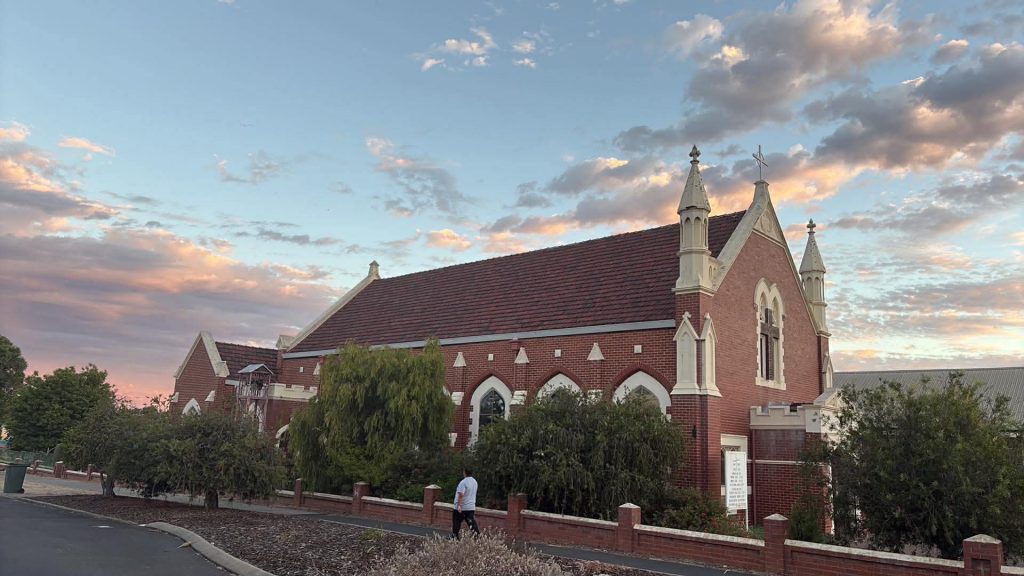
June 1936: New brick church blessed and dedicated.

1953: Extensions to convent school blessed and opened.

1955: Blessing and official opening of St Edmund’s Christian Brothers’ College.

June 1960: First parish paper called the “Ave Maria” was published.

October 1960: Parish was handed over to the Franciscan Fathers.

August 1962: Presentation Sisters diamond jubilee.

April 1965: St Mary’s Church, Darkan blessed and opened.

May 1979: New convent opened.

1981: Arrival of FMM Sisters to the town.

1987: Christian Brothers leave Collie.

July 1991: History made in Collie with the ordination to the priesthood of Brother Leo Grigg.

July 1996: A thanksgiving Mass to honour 95 years of service by the Presentation Sisters who left the school in 1995. December 1996: Farewell and thanksgiving Eucharist for FMM Sisters who left WA July 1997: Blessing dedication of stained glass windows by Bishop Peter Quinn

PARISH PRIEST

Rev. Fr. Gerald Tan

Sunday Masses:
 Saturday (Vigil) – 6:00 PM
 (1st, 3rd, 5th) Sunday – 9:00 AM

First Saturday – 9:00 AM

Weekday Masses:
Wednesday and  Friday – 9:00 AM

Reconciliation:
By Appointment

Devotions:

First Friday Adoration – 9:30 – 10:30 AM

First Saturday Adoration – 9:30 – 5:00 PM

Dardanup Parish – History

Dardanup. a small town in the South West of Western Australia, is a centre for the dairy industry.

The first settler came to Dardanup about 1848. The first Catholic priest to visit Dardanup was Fr T. Donovan in 1851.

On 19th October 1852 Thomas Little drew up a deed in which he donated 50 acres of his holding at Dardanup Park for the purpose of building a church and a monastery, also with a request that a resident priest be appointed as soon as possible. He added a further donation of 100,000 bricks and 50 bushels of calsomine with an approximate value of One Hundred Pounds. The sole condition was that two Masses be offered annually for his intention.

At this time, visits by Catholic priests to the area had been spasmodic. Bishops Brady and Serra from Perth had made occasional visits, as did Bishop Salvado who was the first prelate to pay a pastoral visit to the district on horseback. Bishop Griver also paid periodical visits as did Bishop Gibney.

Bishop Salvado OSB of New Norcia, then acting Bishop of Perth, (Bishop Serra of Perth was away in Rome) laid the foundation stone of the church on 25th March 1854, on the Feast of the Annunciation of Our Lady. Canon Martelli preached nn the occasion and described the foundation laying ceremony: “it was in the midst of the woods under the canopy of heaven that the ceremony was accomplished, not with pomp but with great spiritual joy”.

Its title name, however, is its greatest glory The Immaculate Conception of Mary the Mother of God. Catholic Church, Dardanup (1854—1938).

The little church was named in honour of Our Lady’s Immaculate Conception, a Dogma not proclaimed until 8th December 1854. (Although it was not opened until 1st April 1857). It had the distinction of being the first country parish church of Western Australia outside Perth and Fremantle, but also it supported the title of Church of the Immaculate Conception before Pope Plus IX confirmed that belief of the faithful by decree.

Seeing the growing number of children of Irish Catholic settlers in the little hamlet of Dardanup, Mr Little opened his home “Dardanup Park” in 1854 and employed a ticket-of- leave man, Mr Tom Clancey, to teach them. When Fr Aragon was appointed he visited the school to assist Mr Clancey occasionally.

On Bishop Serra’s return in 1855, Fr Peter Aragon OSB was appointed as resident priest. Fr Aragon’s responsibilities included Australind, Bunbury, Dardanup, Vasse, Busselton and Augusta.

He was a permanent guest of Thomas Little during his tenure which ended in April 1856, when he left the Colony to go to Ceylon. The people retained an affectionate remembrance of him, and he once sent the Littles a gift of cinnamon. He died in Ceylon in 1862. Fr Venancio Garrido was appointed in his place. The second Spanish monk to administer to the religious needs of this Irish community was officially appointed Roman Catholic cli apl am in the Bunhury district by Governor Kennedy and received a government stipend of One Hundred Pounds per annum from the Colonial Administration.

Fr Garrido arranged for a parish meeting to boost the drawn-out construction of the church building. A system of interest free loans was devised at a meeting in October 1857. He completed the church and blessed iton 19th April 1857.

When the new church was completed, the school transferred there. The first school examination was held in 1857 and in that year Mr Tom Clancey left Dardanup for Perth, his place being taken by Miss Anne McKinley.

The parish was very extensive, and Fr Garrido travelled often to the Vasse, to Augusta and to the Blackwood River. He states in his returns on lstJanuary 1858 that the population of Dardanup was 130, of whom 100 usually attended Sunday Mass. Fr Garrido was also responsible for helping establish the first school in the district. He introduced a system where each Catholic fanner in the district gave a portion of grain per harvest to support the church and the pastor.

This also was made possible by the generosity of Thomas Little, for he donated extra land and a small school was built in front to the east side of the church which opened on 15th September 1857 with 25 children. The parishioners came to have a deep affection for Fr Garrido, which he reciprocated. This idyllic existence came to an end on 26th April 1858, when Bishop Serra abruptly ordered him to leave the Colony. He left on 29th July 1858. From Ceylon he kept in touch with his friends, eventually he returned at the request of Bishop Salvado, arriving on 31st December 1859. He spent the rest of his days at New Norcia, where he died in 1870.

The school building also doubled as a dwelling place for the schoolmaster In 1860 there were 40 pupils enrolled in the school but by 1870, due to lack of numbers, the school was closed for several months. Miss Ellen Costello, who was born of Irish Catholic parents in Bunbury in 1855, having obtained her Teaching Certificate, came to Dardanup to teach in 1871. Another school examination was held in 1877 with a very favourable report being received. Miss Costello remained there until the end of 1877.

Later Ellen Costello became Mother Angela, the first Australian born superior of the Sisters of Mercy in Bunbury in 1897. In 1881 the little Catholic school of approximately 15 pupils was taken over by the Government and run as a State school under the guidance of Mr J. Macguire, and later in 1885 by Miss Mary Anne Cleary. By 1891 the classrooms were reported to be in a state of disrepair, poorly equipped and with very little facilities. 1897 saw the withdrawal of the pupils from the Catholic owned building to a more modern structure built opposite the church and run as a State school.

Fr Garrido’s place was taken by the colourful Belgian, Fr Ladolphus Lecaille. He arrived in Dardanup on 17th July 1858. In spite of the attractions of the Little household, he found it more convenient to have a presbytery of his own; he built one in Bunbury about March 1860. Fr Lecaille was of small stature, but of bounding energy He threw himself body and soul into the work of his priesthood and the life of his people. He had great organising ability; he was a man of learning and attainments. He left Bunbury early in 1865 to take up his life’s work in the north at Geraldton. He died in 1908, and was buried in Perth. However in 1936 his remains were re-interred in the mortuary of Karrakatta cemetery. A stained glass window in St Francis Xavier’s Cathedral, Geraldton is dedicated to him. Fr Lecaille was succeeded by several other priests who worked in the South West district: Fr Donovan, Canon Raffaele Martelli, Fr Thomas Lynch, Fr Patrick McCabe, Fr Brady, Fr Delaney and Dean Luigi Martelli (nephew of Canon Raffaele Martelli) who came at the turn of the century. Followed with Dean L.J.Smyth who succeeded him in Bunbury.

On 5th November 1877 Mr Thomas Little died at Dardanup in impoverished circumstances. His property sold and he was permitted to live out his last days at Dardanup Park.

In 1883 the Sisters of Mercy came to Bunbury and established a convent and school, and in their mission visited Dardanup to instruct the children in their catechism and visit the people — no doubt travelling by horse and cart.

In 1920 three Sisters of Mercy leased the local residence known as Prinsep Park in Dardanup to establish a Catholic school. Srs Columba, Finian and Berchmans were the first Sisters. The people were very receptive to the Sisters and set about raising funds to build a convent and school.

School began on 12th April 1920 with 21 pupils. The importance of being able to read and write received much attention at each of the class levels. Resources and financial benefits were afflictions that were more or less experienced by families, teachers and pupils. The Great Depression years rolled in and on, and brought many hardships. 

The school and convent buildings commenced on 22nd May 1921 and was completed on 6th February 1922. The new two storey convent and school was officially blessed and opened by Archbishop Clune on 2nd April 1922 as the Convent of Mercy.

With the Catholic population ever increasing, the need for a new church was imminent. The foundation stone of the new Church of Our Lady of the Immaculate Conception was laid on 12th December 1937 by Archbishop Prendiville. It was completed and officially blessed by Archbishop Prendiville on 1st May 1938. Not only was a new church erected at this time, but a much needed presbytery was built. In 1938 the old church was deconsecrated. The old church was now used as a classroom by the Sisters of Mercy due to the ever increasing number of enrolments and convent facilities overflowing.

Meanwhile the contours of the Dardanup parish had changed considerably. In 1929 it was extended to cover Harvey, Wokalup, Mornington and Brunswick. Two years later, Brunswick stayed with us, but the rest returned to the Harvey parish. In 1935 Australind and Picton were added to Bunbury and Donnybrook became a separate parish in 1937. 

Again so great were the numbers of children attending the Catholic school (60) and so small the accommodation that the parishioners were asked to face the burden of a new school, which undertaking they readily and willingly accepted. A “busy bee” was called and the foundation of the school was laid by the good number who so willingly gave their labour. The two classrooms were completed. On Sunday 10th July 1949 they were officially blessed and opened by Archbishop Prendiville of Perth. The school was then officially named Our Lady of Lourdes. A third classroom was completed in February 1952; payment being from the farming community who each gave a calf to church funds. School numbers have now swelled to 86 pupils.

In 1954, a Marian year, Dardanup had many celebrations. The centenary of the old church 1854 – 1954. 

On 23rd Sunday, with all the children home from boarding schools etc, the Masses were celebrated at Waterloo, Boyanup and Dardanup. Two hundred and fifty received Holy Communion — being over 90% of the parishioners. At 11.00am the Most Rev. L.J.Goody, Auxiliary Bishop in Perth, celebrated Pontifical High Mass. 

On 8th December, 1954 Marian Year was concluded with the opening of a shrine built to commemorate the centenary of the church and in gratitude to the Mother of God. The annual Sunday procession was from Bunbury for the occasion. The closing of the Marian Year Most Rev. Dr Goody officiated at the occasion. Many floats depicting Our Lady’s Title formed the procession and by using loud speakers, the singing was made continuous from Bunbury. It was the largest gathering of people ever seen at Dardanup. The rally of the Holy name society held that day at Dardanup helped to swell the numbers.

A bushie school was held annually at Dardanup making use of the existing school rooms and spacious verandahs. Children came from outlying areas to live-in at the Convent for one or two weeks and were instructed in the truths of their Faith and prepared for First Confession, First Holy Communion and Confirmation. The Sisters, together with extra sisters from Perth, gave up their holidays either in May or August to carry out this work. The last bushie schools were held in 1962.

The Sisters of Mercy continued to teach and occupy the convent building until 1972, having celebrated their Fiftieth Jubilee with a Thanksgiving celebration from the Parish for their tireless work at the school for so many years. In December 1974, the Sisters of Mercy withdrew from the school.

For just over fifty years the parish has been blessed with the Sisters of Mercy teaching the children of the parish.

In 1975 Our Lady of Lourdes School commenced being entirely staffed by lay-teachers.

In 1979 for the 125 year celebration of the foundation of the Immaculate Conception Church in memory of the devout Catholic man who gave the church its Birthplace, the church was renamed the “Thomas Little Memorial Hall”.

The old building. recently restored through the combined forces of the Parish Priest, Parish Council and School Board, was dedicated at 2.00pm on Sunday, 30th September during a special Jubilee celebration.

The convent building was used in many ways by the parish and school until 1977. It was then occupied by the Carmelite Sisters as an enclosed – monastery until March 1984 when the Sisters moved to their new convent in Gelorup. The convent was returned to Parish use.

Later that year the Diocese of Bunbury took it over for use as a Retreat House. It was renamed “Hosea House of Prayer”. The school used rooms for staff and administration this situation continued until 1992 when the new classrooms were constructed.

12th December 1987— Bishop Peter Quinn celebrated the Golden jubilee of the Immaculate Conception Church with us.

1990— Our Lady of Lourdes had 60 enrolled students, of which over 25% come from Boyanup area. Earlier that year, the Education Ministry granted our own school bus.
On Sunday, 28th May 1991, Sister Rita Mary celebrated her golden jubilee as a Sister of St Joseph. Over 200 family and friends gathered at the church to celebrate her 50 years of loving service to God and those around her. After Mass a light luncheon was served at the Shire Hall. Sr Rita left Dardanup to take a new position in Redhill, Canberra, to work under the Popes Apostolic Nunciature.

March 1992 — Father John Joseph McGrath was our next Parish Priest, having left the parish of Donnybrook.

Rosaries for Russia were sent to the Patrick Peyton Centre in America and rosaries were distributed to all parts of the world where needed. This has been an ongoing project, approximately 400 prs have been sent each year since May 1992.

In 1992 the new classrooms incorporating pre-primary facilities were completed and occupied. On 21st March 1993 the official opening of the new school took place with a special Mass celebrated by Bishop Quinn of Bunbury, followed by an official opening in the grounds of the new school. The old classrooms were refurbished and repaired and were put to use as the school library and administration area.

The school office, which was operating from “Hosea’, ‘was moved back into the school premises. One classroom was removed to make Thomas Little Hall more accessible for public viewing.

In October 1994, to mark the 150th Anniversary of Catholic education, the parish had a re-union of past pupils and teachers of our school.

In March 1996 the first newsletter was sent out to all known Catholic persons in the parish. The small newsletter had developed into a spiritual newsletter as well as social, and many good reports have derived from this way of communication, especially for those who do not attend the Sunday services. Two are sent out each year, in March to include Easter Services, and October which includes the Christmas timetable.

Work commenced on connecting sewerage on 1st April 1996. Deep sewerage was put through the whole Parish grounds, school, “Hosea”, presbytery and church toilets.
On 12th May 1996, Bishop Quinn celebrated Mass at Dardanup to bless five new Special Ministers — three from Boyanup and two from Dardanup.

In July 1996 a special rose garden was landscaped at Our Lady of Lourdes new school site. All former students who wished to help make this garden, donated towards a rose in their name.

1999 — School once again took over the Thomas Little Hall for library purposes and music. At these times if the parishioners wanted to socialise with a cuppa tea etc after Mass, the presbytery verandah was used.

April 1999 — The presbytery was fully electrically rewired. The back room was revamped and used for mini worship classes held twice a month on Sundays at the Dardanup church.

24th May 1999 — Feast of Mary Help of Christians: a South West combined country parish day was held at the Immaculate Conception Church. About 40 in number attended, most of these were visitors from outlying areas.



PARISH ADMINISTRATOR

Rev. Fr. Victor Lobo


Sunday Masses:
 Saturday (Vigil) – 6:00pm
 Sun – 8:30 AM LIVE on Facebook

Weekday Masses:
 Wednesday and Thursday – 5:00 PM
Friday – 12:00 NN

Reconciliation:
By Appointment


Dawesville Parish – History

Blessed Damian of Molokai, Dawesville is a new parish decreed on the 22 February 2005 by the Most Revered Gerard J Holohan, Bishop of Bunbury. Fr Leon Russell is the founding Priest.

The parish boundaries are as follows. The northern boundary will be Boardwalk and Casuarina Drive, Halls Head, and the southern boundary will be southern Estuary Road. The eastern boundary will be the Peel Inlet, and the western boundary will be the Indian Ocean.

Today, the parish is under the administration of the Oblates of Saint Joseph priests. 

PARISH MISSION STATEMENT

We are catholics who seek to worship together and support each other in a Parish Community to enliven our faith and reach out to others in Christian love. Strengthened by the Word, nourished by the Eucharist, inspired by the life of Saint Damien, and empowered by the Holy Spirit, we give glory to God and strive for the salvation of all.

FIVE (5) PILLARS OF PARISH MISSION

W – WORSHIP

E – EVANGELIZATION

S – SOCIAL APOSTOLATE AND OUTREACH

T – TEMPORALITIES

Y – YOUTH AND FAMILY MINISTRY

PARISH PRIEST

Rev. Fr. Christian Saminal, OSJ

Weekday Masses:
 Monday – 9:00 AM Liturgy of the Word and Holy Communion

Tuesday – 9:00 AM Liturgy of the Word and Holy Communion

Wednesday – 9:00 AM Liturgy of the Word and Holy Communion

Thursday – 8:30 Cenacle, 9:00 AM Mass

Friday – 8:30 Divine Mercy Chaplet, 9:00 Mass

Saturday – 9:00 AM Holy Mass (NOTE: Liturgy of the Word with Communion on 1st and 3rd Saturday of the month)

Sunday 8:00 AM Holy Mass

Reconciliation:
After Saturday Mass (2nd and 4th Saturday)

Denmark Parish – History

Denmark was originally the name given in December 1829 to the river on which the present town stands. Dr Thomas Braidwood Wilson RN, who explored the area, wished to honour his friend Dr Alexander Denmark RN. Dairy farming, potato and fruit growing and timber formed the main industries in this 46 inch rain belt. The town stands on a large inlet from the sea and has a population of approximately 4,100. It was constituted a parish in 1950. Denmark is 320 krns from Bunbury and 447 kms from Perth.

It would appear that the first priest to have officially visited the present Denmark Parish was Father Bernard Delaney, an alumnus of Maynooth College, who came to this State as chaplain in the convict ship “Hougomont”. He decided upon arrival to remain, and was sent to Albany by the Vicar General of Perth, the then Father Martin Griver, in 1868. Father Delaney remained in these parts until 1876.

Father F Mateau, a Spaniard, was the next priest at Albany and early settlers around Torbay and Bornholm recall him visiting the timber men and saying Mass for them. When the new town of Denmark River started in 1895 Father Mateau occasionally came here and offered Mass in private houses.

During his term, sometime in 1900, the Millar Brothers built a wooden church for their Anglican workers and a few months later also completed a similar church for the Catholics. This church was opened in that same year by Bishop Gibney. When Bishop Gibney was still Father Gibney, he ministered to the Ned Kelly gang in the blazing hotel at Glenrowan, Victoria. Father Mateau’s assistant (from 1899 on) was Father Thomas Morris who also said Mass “at the Denmark”.

Father Michael Reidy was in charge of Albany from 1903 to 1906. In 1905, as the mills started to close down and most of the Catholic population commenced to drift away, Father Reidy took the furnishings and the iron roof off the Denmark church down to Ravensthorpe to complete a church there. The walls were left standing here until the building remains collapsed. Local pioneers still consider this an “act of injustice”. Mass was then said in the local hall or houses from 1906 until 1929.

Father J. Reidy served the needs of the people about Albany from 1906 to 1910. He as succeeded by Father Briody who remained until 1918. For the year 1915-16 of Father Briody’s holiday abroad, Fr Sheridan was in charge.

Father Thomas Gilroy (later Dean Gilroy) took charge of Albany in 1918. The Group Settlement Scheme vas set up in Denmark during his pastorate and the building of the railway line from Denmark to Nornalup brought a further temporary influx of people into Denmark. Father Gilroy took the opportunity presented by their presence to build a second church at Denmark.

St Mary’s Church was opened on 27th October 1929 by Archbishop Clune who was assisted by Frs Gilroy and Prendiville. The builder was Mr George Duckett of Mount Barker and the church was opened free of debt. Mass was said in St Mary’s monthly — sometimes more often from that time until 1936.

Mount Barker and Denmark parishes were joined in 1937.  In that March 1950, Denmark once more became a separate parish comprising the districts of Bornholm, Denmark, Elleker, Nornalup, Scotsdale, Torbay and Walpole. 

The first Parish Council was formed in 1988. Now meetings are held monthly in the parish house.

The church was re-roofed in September 1991 and painted externally in May 1993. The parish house was re-stumped and internally remodelled in May 1998.

The parish purchased a parcel of land (1.6390 ha) Lot 321 Buckley Street, in June 1993 as a future church site. The Bishop of Bunbury purchased an adjoining block of 1.4293 ha in South Coast Highway, making a total area of 3.0683 ha.

After many years of working in the parish on an ad hoc basis, a formal agreement was entered into with the Sisters of St Joseph of the Apparition on 10th February 1998 with the appointment of Sr Bernadette as Pastoral Associate.

A Conference of St Vincent de Paul was formed in the parish in December 1998.

Parish Property

The church was built on Denmark Town block 102 which is the block on which the first church was built in the timber-mill days. 

The parish holds a grant of block numbers 248, 249 and 250 in Millar Street as a possible school site.

PARISH ADMINISTRATOR

Rev. Fr. Edcel Silva, OSJ

Mass Times:

  • 1st Sunday of the Month:    8:30am
  • 2nd – 5th Sundays of the Month: 10:30am
  • Weekday Masses:   9:00am – Wednesday (Chapel),  Friday  and 1st Saturday of the month
  • Reconciliation:    5:30pm Saturdays,  or by Appointment


Donnybrook Parish History

Named after a town in Ireland, famous for its fair, Donnybrook is situated amid fertile and scenic hills and valleys, about 40 kms southeast of Bunbury.  The area is renowned for its fruit growing industry and has the origin of the “Lady Williams” apple to its credit. Timber cutting and dairying were early industries, along with the quarrying of the famous “Donnybrook stone”.

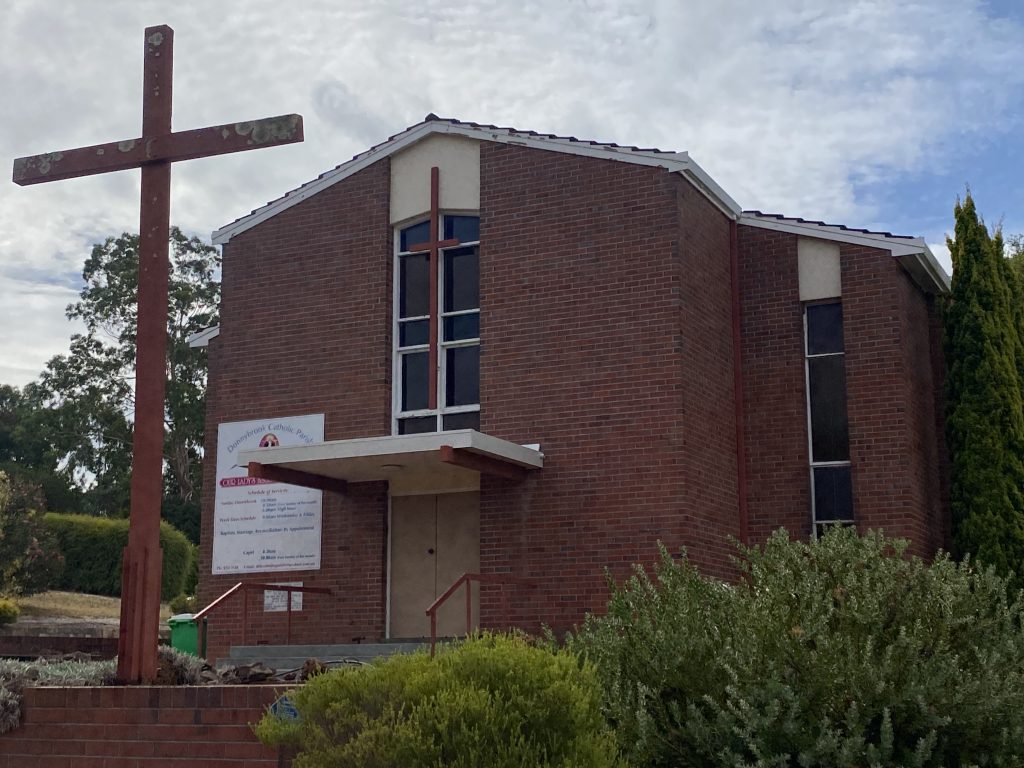
The Church, dedicated to Our Lady of the Assumption and generally known as St Mary’s, is in Bentley Street.  The Parish School, St Mary’s, is situated behind the Church and caters for children from Kindergarten to Year 6.  St Mary’s Parish Centre (former Convent), further up the hill, was set up in 1996 to provide facilities for office, hospitality and meetings.

The Parish Priest resides at the Presbytery in Donnybrook and serves the towns of Donnybrook, Capel and Kirup.  Capel is about 30kms south of Bunbury, along the winding Capel River, so named by the pioneering Bussell family.  The story is that they camped by the river and named it after their daughter, Capel.  Dairying was the early major industry, with some orchards along the Capel River.  The advent of ilmenite mining in the 1960s has led to the growth of industrial mining and refining of other minerals west and east of Capel.

History – Donnybrook (Mass Centre)

After the first recorded visit by the Catholic priest from Busselton in 1889, Donnybrook became part of the new parish district created by Bishop Gibney in 1900 for the three towns of Bridgetown, Greenbushes and Donnybrook.  The first church, established about 1902, was a small wooden structure on low lying ground in Allnutt Street.  After winter rains it was said to resemble “Noah’s Ark”.  Only after the opening of the school on Convent Hill in 1916 was the church transferred to the new site “above the waters” where the preset church now stands.  Under the inspiration of Fr John Walsh and with the help of local volunteers the new brick church, St. Mary’s, was built and dedicated on 12 October 1969.

In 1916, Sisters of Mercy arrived in Donnybrook and opened St Philomena’s School and Convent in the prominent position known as Convent Hill (now Bentley Street).  The wooden buildings, made of local timber probably due to wartime restrictions, stood the test of time and were still in existence long after the construction of a new brick school in 1958.  Since then, additions have further improved the school which is now known as St. Mary’s.  1999 saw the opening of a very up to date kindergarten building.

Present

An active Parish Pastoral Council assists the Parish Priest in cultivating a sense of partnership and collaboration in carrying out the mission of the Church in this rural parish.  The Council has representatives from Capel and Donnybrook Mass Centres and Committees focusing on Liturgy, Community life, Justice and Welfare, Education and Formation.  

Spiritual and social events, such as Shrove Tuesday, Capel Seder Meal, Parish Festa on the Feast of the Assumption, and the Feast of St Joseph, are honoured traditions within the Parish that help foster the growth of community, spirituality and friendship.  

Faith education programs are held regularly, especially during Lent and Advent.  An RCIA journey is held when required for those seeking to become Catholics.  School Masses and Liturgies help to foster a sense of inclusion and community between School and Parish.

An active Parish Finance Committee with representatives from Capel and Donnybrook assists the Parish with Risk Management, good Governance, proactive Maintenance and prudent Financial Management.

A new Grotto – constructed from Donnybrook Stone – was built in front of the Donnybrook Church  in 2025 to have a visible place to honour Our Lady of the Assumption, to whom the Church is dedicated.

PARISH PRIEST

Rev. Fr. Wayne Bendotti

Mass and Reconciliation Schedule

Sundays – 8.30 am
Vigil Mass – 6 pm

Daily Masses:
Tuesday – 9 am
Wednesday – 9.30 am
Thursday – 9 am
Friday – 9 am
Saturday – 9 am

Reconciliation – 5 pm Saturdays

Devotions:
First Fridays – 9.30 am to 12 nn – Adoration/Benediction
3rd & 4th Fridays – 9.30 am to 10.30 am – Adoration
Mondays – 2 pm – Group Meditation
Wednesday – 9 am to 9.30 am – Holy Rosary
Wednesday – 10.30 am to 11.30 am – Wednesday Group Prayer Session
2nd Fridays – 10 am to 11 am – Catholic Men Prayer Session

A Cross Rises in the South…

The historic first Mass in Dunsborough’s new Catholic church, ‘Our Lady of the Southern Cross’, was celebrated at 6.30 pm on Christmas Eve, 1990.  It was a Mass for children.  Together with their parents and many holiday-makers, four hundred attended.

The decision to build a church to hold four hundred, with an overflow area for many more, in a small village where the permanent Catholic community numbered only about fifty, had been justified.  Bishop Quinn had foreseen the needs, not only of the permanent community, but of the rapidly increasing number of visitors from Perth and elsewhere seeking solace in the tranquil South-West.

He appreciated that although their visits are often brief and mostly over the Christmas and Easter periods, their spiritual needs had to be met.  Also, he was aware that many people were retiring to live in Dunsborough.

The old church, ‘Star of the Sea’ had served the community well for thirty-three years.  It was originally a convent classroom in Busselton.  For some years it had been unable to accommodate the holiday season visitors.  It will be sadly missed.  So many memories.  So many Masses and inspired sermons.  So much country-style community spirit.  So many wonderful priests.

Father Ned Kenny was one such priest.  Acting on Bishop Quinn’s instructions, he was responsible for finding and purchasing the land on which the new church now stands – a magnificent, tree-covered site of 3.27 hectares.  Father Ned died in October, 1988, before the decision to proceed with the building of a new church had been made.  The Baptismal Font is a memorial to him.

One of the first actions of Father Ned’s successor as Parish Priest, Father Leon Russell, was to call a meeting of parishioners to elect a building committee – the date, 13 February 1989.

A committee of seven, under the chairmanship of Mike McMullan, spent the next few months coming to grips with the challenge, examining the needs of the community, looking at other sites offered in exchange for the Kenny site, talking to the Shire Council, solving basic building problems and checking available finance.

On 20 June 1989, the committee made their most important decision – the appointment of Iris Rossen and Associates as architects for the project.  The brief to her was extremely brief, about half a typed page, well spaced. 

The committee offered her plenty of scope for creativity, restricted her with a relatively small budget and charged her with a big requirement – design a practical church, beautiful in its simplicity, to house four hundred.

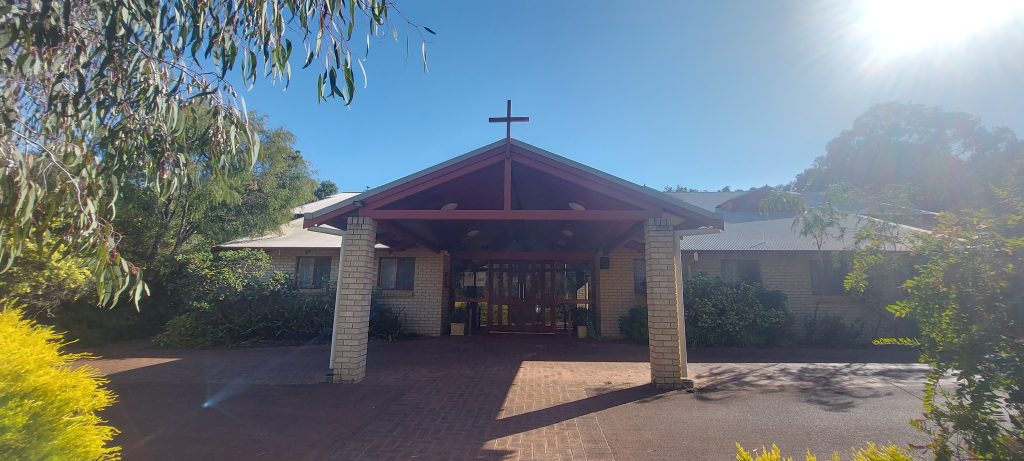
The finished church complex is evidence indeed that the challenge was met and conquered with distinction by Iris Rossen and her supervising associate, Noel Ryan.  It is generally agreed that the finished complex has a dignified beauty, both inside and out, enhanced by the grandeur of its surroundings.

After seeing early plans, Bishop Quinn made only two practical suggestions, one of which was moving the whole complex closer to Naturaliste Terrace, thus keeping a larger area of land to the west free for future development.  This was done.

About this time a number of important volunteers came forward.  Theo Newhouse offered his own consulting-engineer firm’s valuable services free of charge, as did plumbing consultant John Cartwright and forester Barney White, who started the ball rolling by identifying and diagnosing the condition of every tree in the immediate area.  These gentlemen saved the community thousands of dollars.

The builder, Bill Eades of Busselton, was appointed by Iris Rossen after competitive tender – his was by far the lowest quote.  Construction started in May, 1990.  Delays were caused by unexpected clay – this added considerably to costs – and a very wet winter that hampered bricklaying.  But Bill’s team did the impossible and finished in time for the Christmas Masses.

The unexpected costs in particular placed a very heavy burden on the community.  From the start it was realised that the Busselton Parish alone, which includes the small Dunsborough congregation, could not service the anticipated debt.  They already had heavy commitments.  It remains the optimistic hope of the Parish Council that those owning holiday homes, holiday visitors and tourists, the three categories for whom 90% of the church was built, would be generous.  Sponsorship of essential church items was also encouraged.

An important acknowledgement must be made to the anonymous parishioners, small in number, who served on the building committee, organized fund-raising street stalls, entertainments and auctions, cleared the land, planted hundreds of shrubs and planned the opening day’s celebrations.

Four parishioners, however, must be named.  Firstly, Mark and Judith Fisher, who designed and built the sanctuary furniture and at a very charitable price.  They received help from Allan Button, who also made and donated the Processional Cross and statue pedestal and restored the Stations of the Cross.  Their furniture adds much to the beauty of this church.  We were lucky indeed to find such artisans within our congregation.

Finally, Bill Eades, Busselton parishioner and master builder who, together with his sons Andrew, Jamie, Stephen and Christopher, built the church with skill and love.  Bill’s first job as an apprentice carpenter in Busselton had been to build the pews of the old Dunsborough church.  These pews still serve today in the new church.

David Smith, operating out of the Old Court House in Busselton, is to be congratulated on the making of the stained-glass windows, to a design by parishioner Bill Prior.  The large window serves as a backdrop to a beautiful carved wooden statue of Our Lady of the Southern Cross by Englebert Piccolruaz of Sydney. 

The Dunsborough congregation was honoured by the presence for a week after the first Christmas Masses of Bishop Myles McKeon and, later, for almost a week, of the Archbishop of Perth, the much loved William Foley, who died suddenly shortly after returning to Perth.  Both said Mass daily in the new church.

By the early presence of two such eminent Bishops, Our Lady of the Southern Cross displayed her joy and approval in a very subtle way in the building and, finally, in the consecration of a new  home for her Son.

OUR PARISH VISION:

To be a thriving Catholic community, engaging and welcoming.

OUR PARISH MISSION:

Journeying together with God; growing in FAITH, HOPE and LOVE, through fellowship, outreach and service.

PARISH PRIEST

Rev. Fr. Roberto Archie Carampatan

SUNDAY : 9:00 AM

SATURDAY: 6:00PM

Weekdays:

Monday to Saturday: 9:00 AM

Reconciliation: 20 Minutes before Saturday and Sunday Masses or by Appointment


Esperance Parish – History

The first recorded history of the area dates back to 1792. Driven by a storm, the French ships — La Recherche (Search) and L’Esperance (Hope) sought refuge in the lee of what is now Observatory Island, approximately 1 km from the mainland.

The founder of Esperance, Andrew Dempster, in company with his brother William and others set out from Northam in search of more grazing land. They were granted land in Esperance by the Government in December 1863.

The date of the first visit of a Catholic priest to Esperance is unknown, but it is recorded that the Mass was offered in Esperance by the French priest attached to the expedition commanded by Bruny DEntrecasteaux, Fr Louis Ventenat, naturalist and chaplain on the “La Recherche” and Fr Pierson, astronomer and chaplain of the L’Esperance, in December 1792.

In 1929, Fr Langmead (a military chaplain) was appointed as the first resident priest of Esperance who was followed by Fr Charles Cunningham 1932—1933. The parish then extended from Esperance northwards to Widgiemooltha and from Hopetoun eastwards to Eucla. In 1933 Esperance was attached to the parish of Kalgoorlie and remained there until 1936 when Norseman was established as a parish with Fr Stinson as Parish Priest. The boundaries of Norseman Parish went as far as Esperance. Fr Stinson was succeeded by Fr Michael Byrne in 199 who built the first Catholic Church in Esperance. The church was opened in 1960.

22nd November 1960 — a great date to remember — saw the appointment by Bishop Lancelot Goody of a resident priest, Fr William Kevin Glover, a dynamic priest who became a legend in his own time. With his enthusiasm and genuine concern for all people, he became a vital part of the parish and community, being responsible in the sixteen years he served as Parish Priest, for many projects in the parish, town and country areas.

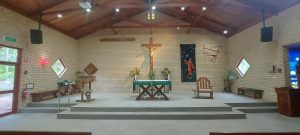
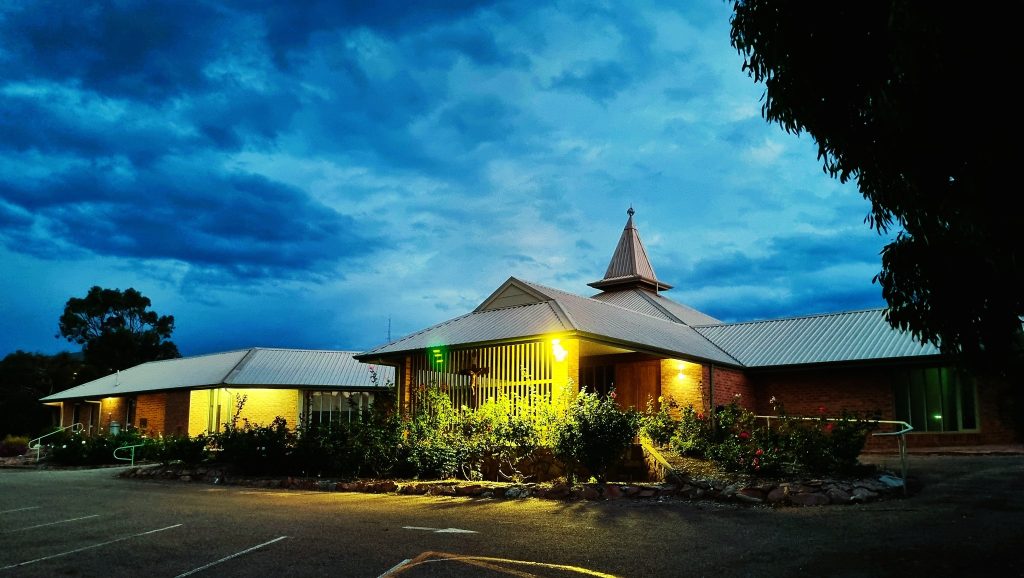
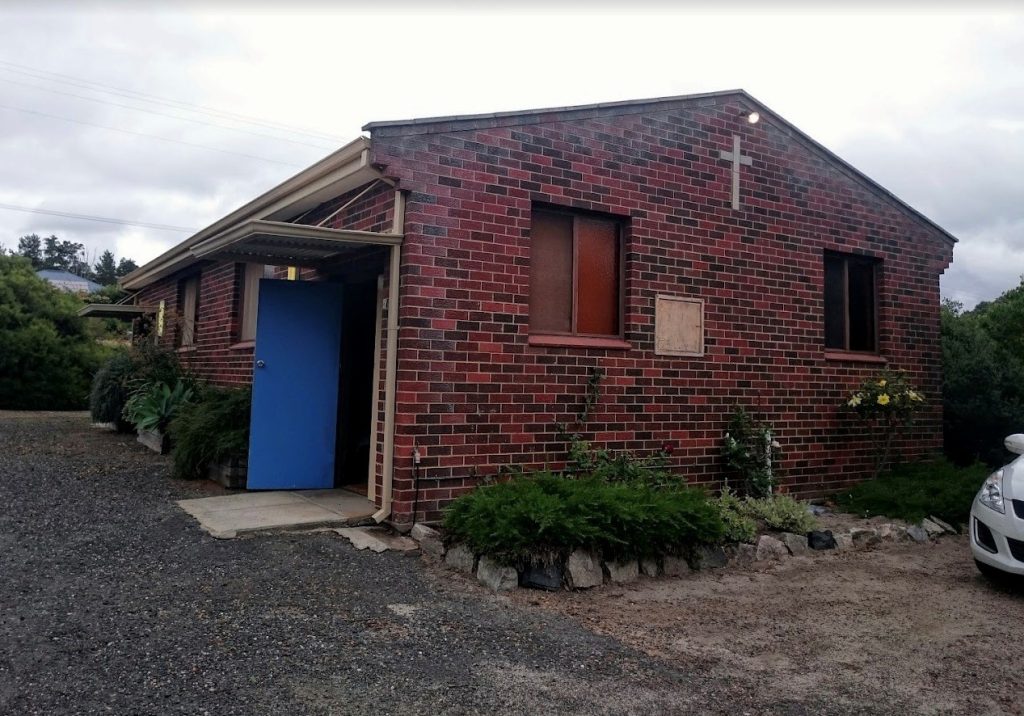
On the 9th May 1979, the very first meeting was organised to make plans for the building of the new church, convent, presbytery and parish centre. Fr Pat Rooney was then the Parish Priest. Together with a church building steering committee the parish built a beautiful church. The opening and blessing of the church took place in April 1982.

In 1980 Bishop McKeon advised that the Salvatorian Fathers would be working in the parish. At Christmas 1981 Salvatorian Fathers took over the parish. 

It is necessary to mention the great involvement of the Sisters of Mercy in the early stages of the parish and later the Sisters of St Joseph of the Sacred Heart, especially the Motor Mission Sisters.

A whole new area began in 1993 with the opening of the parish Catholic primary school, under the Principalship of Anne Nolan, who joined two Salvatorian Priests and two Josephite Sisters, Sr Mary Englebrecht and Sr Kathleen Leane. In the parish, the school is integral. So much of the parish population is invested in the school and the parish has unfolded to embrace the school population.

There are Mass Centres in Grass Patch, Salmon Gums, Cascades, Munglinup, Dalyup, Condingup and Esperance.

PARISH ADMINISTRATOR

Rev. Fr. Marek (Mark) Paczka, SDS

1st, 3rd and 5th SUNDAY: 11:00 AM


Reconciliation: By Appointment

The discovery of tin in Greenbushes in 1886 caused the developing town to outstrip Bridgetown’s population and it was made a separate parish from 1905 until 1915, when it became a part of the Bridgetown parish again.

Greenbushes was the earliest of the towns settled in the Bridgetown Parish and is situated 15 kilometres north of Bridgetown itself. It was established as a mining town in 1888 and rapidly  attracted a large population. A church, convent and school were built and the latter staffed by the Sisters of St John of God. The parishioners of Greenbushes have always been served by the priest of Bridgetown. The presence of the Sisters and the school’s existence was short lived and the building was eventually moved to Nannup in 1939.

For many years the children went into Bridgetown during the school holidays for “Bushie School”. They stayed at the convent and were prepared by the Sister to receive the Sacraments of Confession, Holy Communion and Confirmation. In later years, the Motor Mission Sisters came and taught Religion Classes in the local school.

The original church at Greenbushes was burnt down in 1973 and a new church was built and furnished within a year. This church is used by the Greenbushes and Balingup communities on the first and second Sundays of each month. On the third, fourth and fifth Sundays the combined church community meets at Balingup. The church is an important meeting place for the community.

PARISH PRIEST

Rev. Fr. Edwin Ocho (St. Brigid’s Parish, Bridgetown)

Sunday Mass

          1st, 3rd and 5th Sunday 8:30 am

          2nd and 4th Sunday 10:30 am

Weekday Mass

         Chapel Mass – Tuesday and Wednesday  9am

Tuesday Prayer Group 6:30pm

Vigil Mass (Saturday) 6:00 pm

Reconciliation every Saturday 5:30 pm

Adoration of the Blessed Sacrament – every Tuesday, 9:00am to midday

About Us


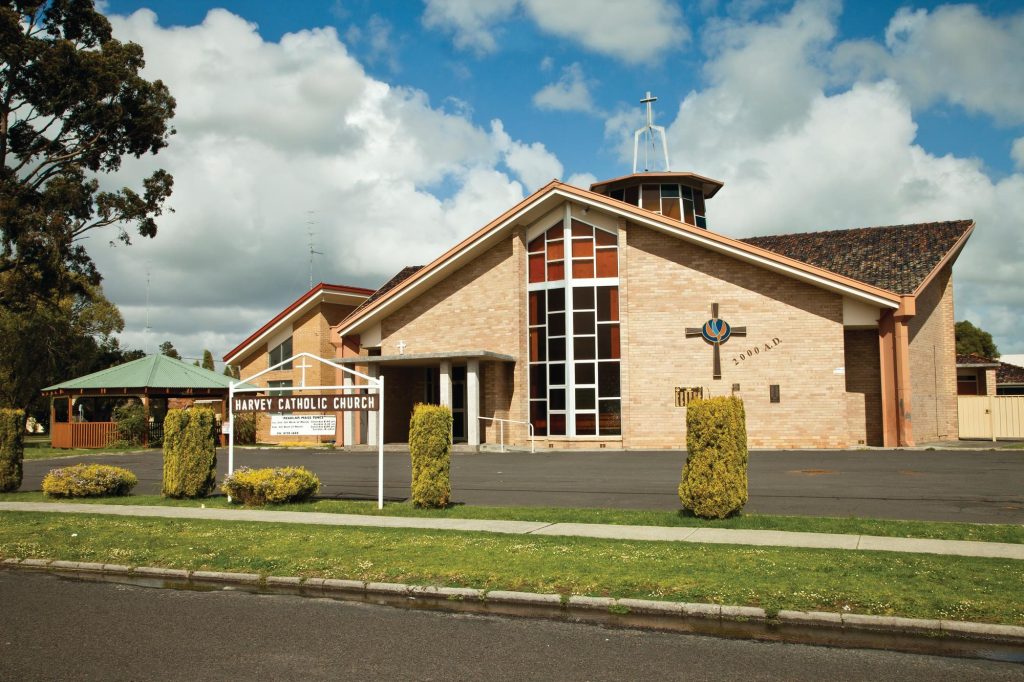
Harvey is the name given to the South West town when it was originally surveyed by Major Harvey in the 1830s and is situated 140kms south of the state’s capital city, Perth.

The town’s major enterprises are dairying, cattle and fruit growing. A large abattoir, juice and milk factory in the town services domestic and export needs and provides employment for many in the area.

There are many families of Italian origin in the district, and on outskirts of town is a shrine to the Italians who were interned there during World War II. Other nationalities prominent in the area are Filipino, British and New Zealand.

Our church is located on the corner of Hester and Young Streets in Harvey. Our parish is called Our Lady of the Immaculate Conception, in honour of our Lady. The name was taken after our first church which was built in 1932. However, in 1972 a new and larger church was built and to recognise the contribution of the immigrants who first came to Harvey, our church was placed under the patronage of Mary under the title of “Our Lady of the Immigrants.”

To celebrate and honour the history of our parish, we celebrate two Festa’s each year, In December, a Festa day is celebrated in honour of Our Lady’s Immaculate Conception has been celebrated each year since 1991.

In October each year, the parish also celebrates a Festa honouring Our Lady of the Immigrants. This celebration was inaugurated in 1954 and is celebrated annually on the second Sunday of October.

Our Lady of the Immigrants Church has a twofold purpose as the parish church and as a shrine for all immigrants. The parish welcomes families from all denominations and our Catholic population has grown to more than 350 families.

The parish now includes a newly completed parish hall named The Kinsella Parish Centre. By way of serving the Harvey community, this multipurpose venue can be hired for celebrations such as Baptisms, Funeral wakes, Wedding Receptions, Conferences and much more. Furthermore, the sacristy was recently refurbished to add a unique chapel, designed and built for smaller gatherings such as prayer groups, rosaries, baptisms and school masses.


PARISH PRIEST

Rev. Fr. Marcelo Rosales, MSP


TO BE UPDATED

PARISH PRIEST

Rev. Fr. Manoj George Moolamthuruthil, HGN